

Watercolor landscape painting is a popular and expressive art form that captures natural scenes such as mountains, forests, rivers, and skies using watercolor paints. This style is loved for its soft, transparent effects and the ability to create mood and atmosphere with simple techniques. Many artists, including J. M. W. Turner and John Singer Sargent, are well known for their beautiful watercolor landscapes.
This article belongs to Wall Art & Design
Introduction to Watercolor Landscapes
Watercolor landscapes are a beautiful and expressive art form that captures natural scenes such as mountains, forests, rivers, and skies using transparent watercolor paints. Many famous artists like J. M. W. Turner and Winslow Homer popularized watercolor landscapes with their unique techniques and emotional depth.
| Aspect | Description | Importance for Beginners |
| What Are Watercolor Landscapes? | Paintings that depict natural scenery using watercolor paints known for transparency and softness. | Helps beginners explore creativity and nature. |
| Key Features | Light, fluid, and transparent effects with soft color blending. | Makes artwork look natural and expressive. |
| Basic Materials | Watercolor paints, brushes, watercolor paper, palette, and water. | Essential tools to start painting. |
| Common Subjects | Mountains, beaches, forests, sunsets, lakes, and rural scenes. | Offers endless inspiration from nature. |
| Color Techniques | Wet-on-wet, wet-on-dry, layering, and color mixing. | Builds foundational painting skills. |
| Brush Techniques | Dry brush, glazing, lifting, and blending. | Helps create textures like clouds, trees, and water. |
| Importance of Light & Shadow | Focus on how light affects landscapes and creates depth. | Enhances realism and dimension. |
| Perspective & Composition | Use foreground, middle ground, and background. | Makes landscapes more visually appealing. |
| Benefits of Watercolor Landscapes | Improves observation, patience, relaxation, and creativity. | Great for stress relief and mental wellness. |
| Learning Resources | Online tutorials, workshops, and art communities. | Supports continuous learning and improvement. |
Understanding Watercolor as a Medium
Watercolor is a transparent painting medium made of pigments suspended in a water-soluble binder (usually gum arabic). Its main characteristics include:
- Transparency
- Layering ability
- Natural light diffusion
- Soft blending effects
- Expressive unpredictability
Unlike oil or acrylic, watercolor relies heavily on white paper for highlights, meaning you must plan ahead rather than paint over mistakes.
Essential Materials for Easy Landscape Watercolor Painting
Watercolor Paint Types
| Type | Description | Best For Beginners | Average Global Price |
| Pan Set | Dry cakes activated with water | Yes | $8 – $30 |
| Tube Paint | Wet paint squeezed onto palette | Yes | $3 – $12 per tube |
| Liquid Watercolor | Highly pigmented fluid | Intermediate | $10 – $25 |
Recommended Beginner Brands (Budget-Friendly)
- Winsor & Newton
- Sakura Color Products
- Faber-Castell
- Daler-Rowney
Watercolor Paper (Critical for Landscapes)
Watercolor paper weight determines how well it handles water.
| GSM | Thickness | Ideal Use | Average Price |
| 190 GSM | Thin | Practice only | $8 – $15 (pad) |
| 300 GSM | Medium | Best for beginners | $15 – $35 (pad) |
| 640 GSM | Heavy | Professional use | $40 – $90 |
Paper Types
- Cold Press (Textured) – Ideal for landscapes
- Hot Press (Smooth) – Detailed work
- Rough – Dramatic textures
Professional paper brands include:
- Arches
- Canson
- Strathmore
Brushes for Landscape Painting
| Brush Type | Use | Beginner Essential? | Price Range |
| Round Brush (Size 6–10) | Trees, hills, details | Yes | $5 – $20 |
| Flat Brush (1 inch) | Skies, washes | Yes | $6 – $25 |
| Fan Brush | Grass textures | Optional | $5 – $15 |
| Mop Brush | Large skies | Optional | $15 – $40 |
Synthetic brushes are affordable and beginner-friendly.
Learning The Fundamentals of Watercolor
It is worth knowing some of the basic watercolor techniques because this can be the difference between a landscape painting and a masterpiece. Wet-on-wet is a favourite method, in which you wet the paper with clean water then apply colour and it diffuses into the paper, it is very good at creating skies or clouds.
Wet-on-dry, however is employed when you desire more manipulation of such shapes as trees, hills, or rocks. The dry brush technique comes in with the aid of making rough surfaces like grass or sand.
Another technique is that of glazing colors over the first one to give the effect of depth and shadow after the first layer has completely dried. These are only a few techniques that when practiced before painting a whole scene will make you feel confident.
Step-by-Step Landscape Painting for Beginners
Landscape painting is a great way to start your art journey. Many artists like Bob Ross and J. M. W. Turner made landscape painting popular by showing simple techniques that beginners can easily follow.
| Step | Process | What to Do | Beginner Tips |
| 1 | Choose Your Reference | Select a simple landscape photo such as mountains, beach, or sunset. | Start with basic scenes that have fewer elements. |
| 2 | Gather Materials | Use paints (watercolor, acrylic, or oil), brushes, canvas or paper, palette, and water. | Good-quality paper or canvas gives better results. |
| 3 | Sketch the Outline | Lightly draw the horizon, trees, mountains, and major shapes. | Keep the sketch simple and avoid too many details. |
| 4 | Plan the Composition | Decide the foreground, middle ground, and background. | Use the rule of thirds for balance. |
| 5 | Start with the Sky | Paint the sky first because it is usually the lightest part. | Use soft strokes and blend colors smoothly. |
| 6 | Add Background | Paint distant mountains or far trees with lighter and softer colors. | Light colors create depth and distance. |
| 7 | Paint Middle Ground | Add hills, water, or larger trees. | Use medium tones and more details. |
| 8 | Create Foreground | Paint grass, rocks, flowers, or pathways. | Use darker colors and sharp details. |
| 9 | Add Shadows & Highlights | Show light direction using darker and lighter tones. | This step adds realism and dimension. |
| 10 | Final Details | Add texture, reflections, or small elements like birds. | Don’t overwork the painting; keep it fresh. |
| 11 | Let It Dry | Allow the painting to dry completely before touching. | Drying prevents color mixing or smudging. |
| 12 | Review & Improve | Observe your work and note areas to improve. | Practice regularly to build skills. |
Helpful Tips for Better Painting Results
The best thing is always to use light colors first and add more colors as darker. Once paint has been put on it is more difficult to lighten than to darken. Paint in the background to the foreground such that each layer is added to enhance depth and not to blur the colors. Allow each layer to dry thoroughly and then apply the next lining so that they do not intermix. You can also experiment using different times of the day or time of the year by changing your color palette. E.g. warm orange shades should be used when it is a sunset and cool blues and purples when it is dawn.
Complete Cost Breakdown for Beginners (Global Estimate)
| Item | Budget Setup | Mid-Range Setup |
| Paint Set | $10 | $35 |
| Brushes | $15 | $60 |
| Paper Pad | $20 | $45 |
| Palette | $5 | $15 |
| Miscellaneous | $10 | $20 |
| Total | $60 | $175 |
Watercolor is one of the most affordable painting mediums compared to oil painting.
Color Theory for Landscape Watercolor
Understanding color mixing is essential for creating depth.
Basic Landscape Color Palette
- Ultramarine Blue – Sky, shadows
- Cerulean Blue – Daytime sky
- Sap Green – Grass, trees
- Burnt Sienna – Earth tones
- Yellow Ochre – Sunlight
- Alizarin Crimson – Sunsets
Atmospheric Perspective Rule
- Distant objects = lighter, cooler colors
- Foreground objects = darker, warmer colors
This creates natural depth in your landscape.
Composition Rules for Beginners
Rule of Thirds
Divide your paper into 3 horizontal and 3 vertical sections. Place:
- Horizon line on upper or lower third
- Focal point off-center
Simple Landscape Layout Ideas
- Sky (Top 1/3)
- Mountains (Middle)
- Foreground grass or water (Bottom)
Avoid placing the horizon exactly in the middle.
Common Beginner Mistakes and How to Avoid Them
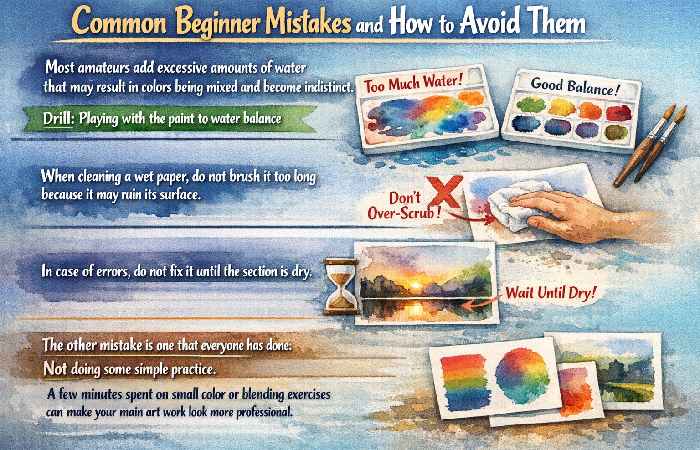
Most amateurs add excessive amounts of water that may result in colors being mixed and become indistinct. Drill: playing with the paint to water balance. When cleaning a wet paper, do not brush it too long because it may ruin its surface. In case of errors, do not fix it until the section is dry. The other mistake is one that everyone has done: not doing some simple practice: a few minutes spent on small color or blending exercises can make your main art work look more professional.
Inspiring Landscape Ideas for Beginners
When you get used to the rudimentary ways, you may attempt to sketch pleasant scenes like a lake with trees in it, or a sunset with mountains in the background, or a wood walk, or a field of wild flowers. All these are simple shapes and gentle colour tints to be made. There is no need in making it perfect, this is the beauty of watercolor its soft, flowing nature. (Udemy)
Advanced Beginner Techniques for Landscape
Lifting Technique
Use a damp brush to remove paint for clouds or light reflections.
Splattering
Flick brush for grass texture or starry skies.
Salt Technique
Sprinkle salt on wet paint for interesting organic textures.
Masking Fluid
Preserves white areas for highlights like river reflections.
Light & Shadow in Landscapes
Light determines mood.
| Time of Day | Color Palette | Mood |
| Sunrise | Pink, orange, soft blue | Calm |
| Noon | Bright blue, green | Fresh |
| Sunset | Orange, red, violet | Romantic |
| Twilight | Indigo, gray, muted tones | Dramatic |
Shadow colors are rarely black. Mix blue + brown for natural shadows.
Easy Landscape Ideas for Beginners
- Mountain and lake reflection
- Beach sunset
- Snowy hill
- Countryside path
- Forest silhouette
- Lavender field
- Desert dunes
Keep shapes simple and avoid over-detailing.
Common Problems & Solutions
| Problem | Cause | Solution |
| Muddy colors | Overmixing | Use clean water |
| Paper warping | Too much water | Tape edges, use 300 GSM |
| Hard edges | Paper dried too fast | Work quickly |
| Blooming effect | Excess water | Control brush moisture |
Practicing Schedule for Beginners
Week 1 – Basic washes and gradients
Week 2 – Trees and mountains
Week 3 – Sky variations
Week 4 – Full landscape compositions
Consistency improves skill dramatically.
Online Learning Resources
YouTube channels and platforms help beginners learn visually:
- Skillshare
- Udemy
- Domestika
Course prices range between $15 – $100 depending on instructor.
Benefits of Landscape Watercolor Painting
- Reduces stress
- Enhances creativity
- Improves patience
- Develops color perception
- Strengthens hand coordination
Many art therapists encourage watercolor as a mindful practice.
Selling Beginner Watercolor Landscapes
Once confident, beginners can sell artwork on:
- Etsy
- Redbubble
- Saatchi Art
Beginner original watercolor landscapes typically sell for:
- $25 – $150 (small size)
- Prints: $10 – $40
Framing & Preservation Costs
| Item | Average Cost |
| Basic Frame | $15 – $50 |
| UV-Protected Glass | $30 – $100 |
| Fixative Spray | $10 – $20 |
Always frame watercolor under glass to protect from humidity.
Psychological & Creative Growth Benefits
Watercolor landscapes teach:
- Observational skills
- Patience
- Planning ahead
- Accepting unpredictability
The flowing nature of watercolor encourages creative freedom rather than rigid perfection.
Conclusion
The beginners easy landscape water painting is about exploring the color, light and emotions. It is best to begin with simple, keep practicing and you will soon find that your skill increases. Each stroke of the brush informs you of something. Therefore, pick your brushes, blend your preferred colours and allow creativity to run your brush over the paper. The larger and larger your landscapes will be the larger the layer by layer landscape painting with watercolor easy is.
